The Growth Leader – Volume 4

We hope you’re Planning, Growing & Succeeding!

Interest rates have been in the news for the past couple of years now, and no more so then when The Federal Reserve (‘The Fed’), the central bank of the world’s biggest economy, the United States of America, cut the official cash rate (OCR) by 50 basis points, or 0.5%, recently.

So, if you couldn’t tell already, this month is all about interest rates.

We get asked all the time ‘…when will the RBA drop interest rates…’. Our short answer? Who knows! We certainly don’t.

It’s an important question to try to answer as if you’re in business or have any sort of finance, interest rates effect you. Our opening article explains how central banks set an official cash rate (OCR), we now bounce into another on what the real interest rate is. And, as a special bonus, we have a piece on why it is believed that labour shortages are the new unemployment – and you guessed it, this has the potential to have a dramatic impact on interest rates.

Spoiler Alert:  We do not prognosticate on if / when the RBA will drop rates, I’m afraid. Our crystal ball just isn’t that good! However if you would like to review your own interest rates, Matthew Robinson our in-house Mortgage Broker is always available for a chat.

How Central Banks Set the Official Cash Rate

Central banks, such as the Reserve Bank of Australia (RBA) or the Federal Reserve (‘The Fed’) in the U.S., play a key role in managing a country’s economy, and one of their most important tools is the Official Cash Rate (OCR), also known as the policy interest rate. This rate is the interest charged on loans between commercial banks and is a powerful lever that central banks use to influence economic conditions.

Why Do Central Banks Set the OCR?

The main goals of central banks in setting the OCR are to:

  1. Control inflation – the rate at which prices for goods and services rise over time
  2. Support economic growth – ensuring that the economy is stable and growing at a healthy pace
  3. Stabilise the financial system – keeping the flow of money between banks, businesses, and households smooth and predictable.

How Does It Work?

  1. Inflation Control:
    • When inflation is rising too quickly, the cost of goods and services increases, which can make it harder for people to afford basic needs. To slow inflation, the central bank raises the OCR. A higher cash rate means banks charge more for loans and mortgages, making borrowing more expensive. As a result, people and businesses borrow less and spend less, slowing down the economy and bringing prices under control. 
  2. Boosting Economic Activity:
    • In times of economic slowdown or recession, businesses may struggle, unemployment may rise, and people tend to spend less. To stimulate the economy, the central bank lowers the OCR. When the cash rate is low, banks lower their interest rates, making it cheaper for people to borrow money to buy homes, cars, or invest in businesses. This encourages spending, which can help boost the economy and create jobs. 
  3. Supply & Demand of Money:
    • Central banks also manage the supply of money in the financial system. By raising or lowering the OCR, they influence how much banks can borrow and lend to each other. A lower OCR increases the money supply, making it easier to borrow, while a higher OCR reduces the supply, making money more expensive and scarcer. This supply and demand balance directly impacts the interest rates consumers see on their loans and savings.

What Factors Influence the OCR?

Central banks don’t set the OCR randomly.  They carefully consider a range of factors, including: 

  • Current inflation:  If inflation is too high, the OCR is likely to increase
  • Economic growth:  Slow growth or recession might prompt a decrease in the OCR
  • Unemployment rates:  High unemployment could lead to a lower OCR to boost job creation
  • Global economic conditions:  International events, like financial crises or trade wars, can, and often do influence the central bank’s decisions

How Does the OCR Affect Us?

The OCR has a ripple effect on everyday life in a number of ways: 

  • Home Loans and Mortgages: When the OCR goes up, banks increase the interest rates on home loans, making mortgages more expensive. When it goes down, home loan interest rates drop, making repayments cheaper
     
  • Savings: A higher OCR means better interest rates on savings accounts, helping people earn more on their deposits. A lower OCR, on the other hand, reduces the returns on savings
     
  • Business Investments: Companies may delay expansion or hiring during times of high interest rates because borrowing costs more (more on this, later). Lower interest rates encourage businesses to take out loans and invest in growth

Conclusion

In simple terms, the OCR is a tool central banks use to influence the cost of borrowing and the flow of money in the economy. By adjusting the OCR, central banks can cool down an overheating economy with rising inflation or jump-start growth during economic slowdowns.
 
This delicate balancing act helps ensure that inflation stays in check, the economy grows sustainably, and the financial system remains stable.

What is the Real Interest Rate and Why Does it Matter?

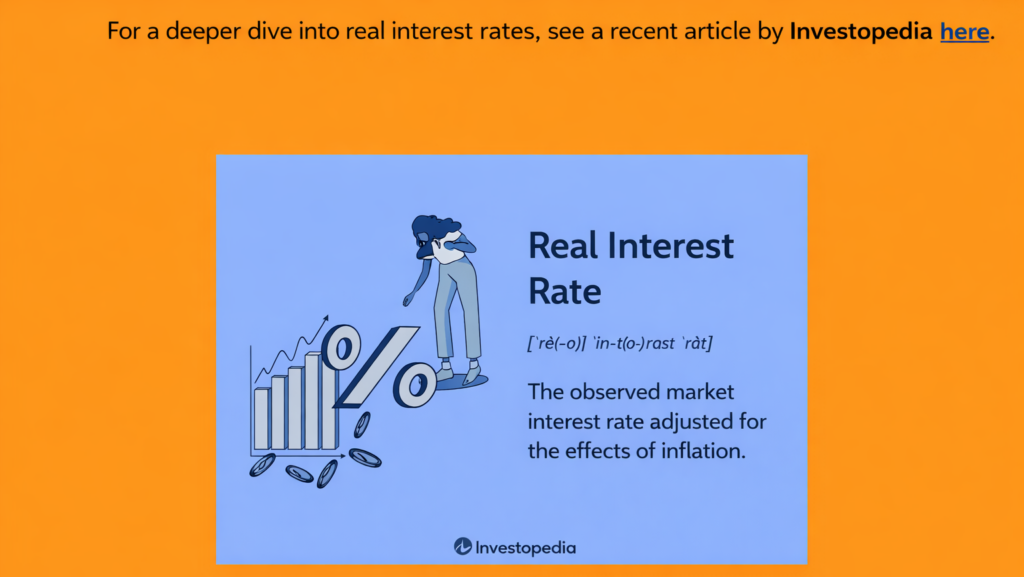
The real interest rate is the nominal interest rate adjusted for inflation. It reflects the true cost of borrowing and the actual return on investments once inflation is accounted for. While the nominal rate represents the face value of interest, the real rate measures the purchasing power of money over time.

For example, if the nominal interest rate on a loan is 5% and inflation is 3%, the real interest rate is approximately 2%. This adjustment is crucial for both lenders and borrowers, as inflation erodes the value of money. For borrowers, a lower real interest rate means less financial burden over time, as the money they repay will be worth less. For investors or savers, a low or negative real interest rate can lead to diminished returns, as inflation eats away at their capital gains.

Why does the real interest rate matter?

It significantly influences economic decisions, from consumer spending to business investments. In periods of low real interest rates, borrowing becomes cheaper, often stimulating economic growth, while high real interest rates can cool off an overheating economy or curb inflation. Central banks closely monitor and adjust nominal rates to indirectly influence real rates, making them key to economic policy.

Labour Shortages: The New Unemployment

In the current global economy, labour shortages have emerged as a persistent and defining issue. Far from being a temporary phenomenon, they represent a structural shift in the job market that signals the “new unemployment.” Here’s why labour shortages are here to stay:

1. Demographic Shifts: An ageing population is one of the most significant contributors to labour shortages. Many developed countries are seeing their workforces shrink as birth rates decline and the baby boomer generation retires. This creates a gap in available labour that is not easily filled by younger generations, whose numbers are simply too small to replace retirees. Immigration, often viewed as a solution, has also been constrained by political and logistical challenges.

2. Shifting Workforce Preferences: The pandemic exposed, and accelerated changes in how people view work.  Many workers now prioritise flexibility, purpose, and quality of life over traditional job security, and this shift has led to a growing mismatch between the jobs available and what workers are willing to accept. High-demand industries, such as healthcare and tech, face chronic shortages, while lower-paying sectors struggle to attract talent.

3. Technological Disruption: While automation and AI were initially expected to displace jobs, they are instead reshaping the skill sets required in the labour market. There is a growing demand for highly specialised skills, leaving lower-skilled workers at risk of obsolescence.  However, education systems are struggling to keep pace with the speed of technological advancement, leading to a persistent gap between the skills employers need and those the workforce possesses.

4. Rising Wages, Stagnant Participation: In many economies, wages are rising in response to labour shortages, but this has not necessarily increased labour force participation. Many workers remain on the sidelines due to health concerns, childcare responsibilities, or a preference for alternative forms of income, and this dynamic has created a paradox where unemployment rates are low, yet businesses continue to struggle to fill positions.


The New Unemployment: A Skills Mismatch

Labour shortages are becoming the new form of unemployment. Traditional unemployment measures the number of people seeking work, however today’s shortages reflect a more complex issue: the growing disconnect between available jobs and the skills or preferences of workers.  This mismatch is unlikely to disappear soon, as structural factors such as demographics, technology, and shifting worker values will continue to reshape the labour market.

In this new era, businesses will need to innovate in recruitment, invest heavily in employee training, and rethink their workforce strategies to remain competitive. Labour shortages, much like unemployment once was, will be a persistent challenge that defines economic landscapes for years to come.

Labour shortages are expected to persist due to structural factors like demographic shifts, technology-driven changes, and mismatches between job requirements and available skills; a trend, identified by experts that is reshaping workforce dynamics globally. 

What’s the Solution?

One key strategy to address this is tapping into so called ‘hidden workers’, those often overlooked in traditional hiring practices, such as caregivers, veterans, or part-time employees. These groups can help mitigate talent shortages if hiring processes become more inclusive.

4Front Mortage Broking Offering

As a trusted partner for your financial needs, we understand that securing a mortgage is a significant step in achieving your homeownership dreams, refinancing goals, or investment ambitions. With our Mortgage Broking service arm, we are uniquely positioned to assist you with your application. Our Accounting, SMSF, Financial Planning and Mortgage Broking teams work closely together to supply data relevant to your loan, saving you countless hours collecting and providing this information yourself.
 
Our team prides itself on their expertise in the SMSF lending space and have already assisted several clients in both purchasing and refinancing property within this space, including residential & commercial.
 
Our Broking team have access to over 30 lenders, each with their own specialties and niches. From PAYG to Self Employed, and every form of income in between, we are accredited with a lender that has the best offer for your circumstance.
 
Whether you’re buying a home, looking to refinance, wanting to own your own commercial property, or seeking to invest in the market, our 4Front Mortgage Broking team is here to guide you through the entire loan process from approval through to settlement.
 
To schedule an appointment or learn more about our offering, please phone our accredited Mortgage Broker Matthew Robinson or your trusted adviser on 07 3875 9888 or email Matthew at [email protected].

Board of Advice Program

In the dynamic world of small-to-medium businesses, navigating the path to success can be challenging.  Our Board of Advice Program can be a transformative step.  It brings a wealth of benefits, from expert guidance and objective insights to risk management and long-term strategic planning. 

As the business landscape continues to evolve, having a dedicated team of advisors can be your key to navigating these changes successfully and setting your business on a path to sustained growth and success. Limited resources, fierce competition, and rapid market changes make it crucial for SMB’s to seek strategic guidance. This is where our Board of Advice Program steps in as a game changer.

If you are ready to consider incorporating a Board of Advice Program, we invite you to book a discovery session with us here: 

Until next time, keep Planning, Growing & Succeeding!

Let’s build a future you can look forward to.  Call us at (07) 3875 9888 or visit www.4front.net.au to get started today.