The Growth Leader – Volume 2

We hope you’re Planning, Growing & Succeeding!

Now that we’re in the 2nd month of the year (and the quarter!) we’re in full on Board of Advice Program mode. For those that are not familiar with our Board of Advice Program, we have a section below dedicated to introducing this to you, and why you should consider incorporating this into your business.

We also have a piece on why companies buy other companies, and a video about the dot.com bubble (quite prescient given the current stock market rumblings), and why it’s important to know your customers’ jobs that they want done.

So, without further ado, let’s hop right into it…

Why Companies Acquire

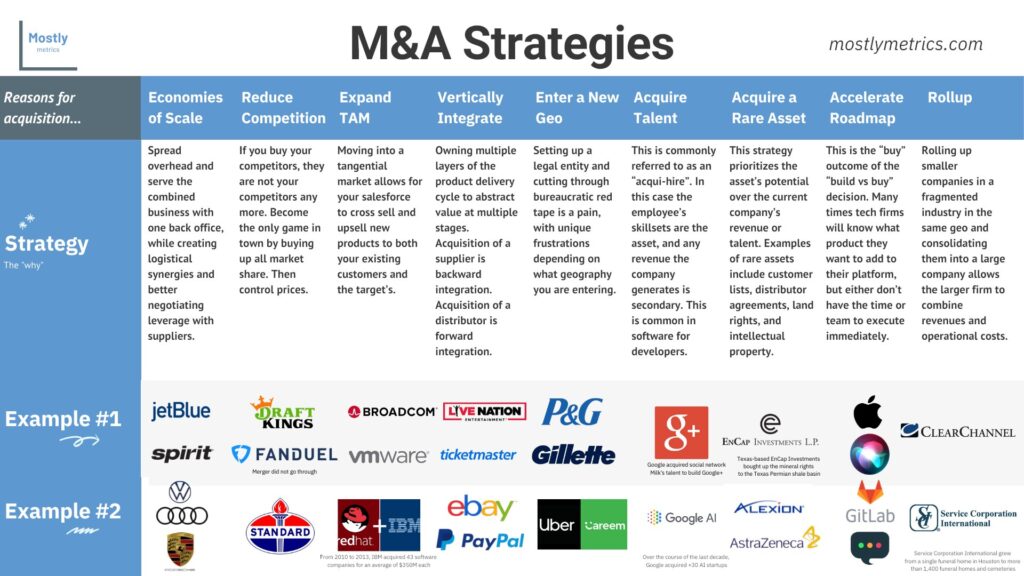
This week we came across this interesting infographic.
 
Initial Public Offerings (IPOs) are always making the news – the most recent of these in the Australian context being Mexican cuisine sensation Guzman y Gomez (Guzman hits the ASX).
 
But did you know that 99% of companies in a transition event are most likely to die, Merge with a competitor, or get Acquired, as opposed to ‘list’?
 
According to Boston Consulting Group in their recent M&A Insights Article, the global value of Mergers & Acquisitions (M&A) activity in the first half of 2024 was a staggering $1.0 Trillion. 

Most M&A strategies occur for one of 9 reasons:

  1. Build economies of scale
  2. Reduce competition
  3. Expand your Total Adressable Market (TAM)
  4. Vertically integrate
  5. Move into a new geographic market
  6. Acquire talent
  7. Acquire a rare asset
  8. Accelerate your roadmap
  9. Rollup

 The infographic here shows the most common strategies, why they occur, and real-life examples.

If you’re ever thinking anything M&A, please get in touch with the 4Front Team as we’re here to help.  We have the right mix of expertise, knowledge and contacts to make your next merger or acquisition a success and have been ‘buy’ side and ‘sell’ side advisors for many of our clients who have gone through many successful M&A transactions.

Inherent Value

Value, as defined by Merriam-Webster has several meanings, however the one that resonates the most we believe is “a fair return or equivalent in goods, services, or money for something exchanged.”
 
Riffing on the Stock Market theme from earlier, this concept was notably absent during the 2008 financial crisis when banks issued mortgages to unqualified borrowers, bundled these risky loans, and sold them, leading to a significant economic fallout (the 2010 documentary Inside Job explains this cataclysm of greed quite succinctly). 
 
Similarly, during the dot-com bubble of 2000, companies with no sustainable business models were raising vast sums of money based solely on owning an internet domain, lacking real inherent value.

Know your Customers’ ‘Jobs to be Done’

Even though this Harvard Business Review article dates back to 2016, the term “Jobs to be Done” is more important than ever and exemplifies the strength of a timeless concept over fleeting trends or quick fixes. Some ideas come-and-go; others truly endure.
 
Businesses have never known more about their customers, but their innovation processes remain hit-or-miss. Why? According to Christensen and his coauthors, to create offerings that people truly want to buy, businesses instead need to home in on the job the customer is trying to get done.

Click on the link above, or on the image below to read the Article

How does this apply to me, you might ask?  When market conditions shift—like rising interest rates, increasing inflation, or waning confidence—it’s crucial to question the inherent value of your business: 
  • Customer Value Alignment: Does the value you deliver align with what your customers pay? Are they likely to remain loyal despite alternatives? 
  • Evolving Strategy: Are you adapting your strategy to enhance value through price adjustments or service enhancements? 
  • Cash Flow and Debt: Is your debt service manageable, allowing you to build a financial safety net? 
  • Customer Dependency: Does your revenue heavily depend on a limited number of customers? 
  • Market Influence on Valuation: Is your business’s valuation driven by your strategic actions or by market trends?
Focusing on improving your business’s fundamental aspects—people, strategy, execution, and cash—will strengthen its inherent value, making it more resilient against external pressures.

Board of Advice Program

In the dynamic world of small-to-medium businesses (SMB’s), navigating the path to success can be challenging.  Limited resources, fierce competition, and rapid market changes make it crucial for SMB’s to seek strategic guidance.

This is where our Board of Advice Program steps in as a gamechanger. 

If you’re ready to incorporate a Board of Advice Program we invite you to book a discovery session with us here:

Until next time, keep Planning, Growing & Succeeding!

Let’s build a future you can look forward to.  Call us at (07) 3875 9888 or visit www.4front.net.au to get started today.