We hope you’re Planning, Growing & Succeeding!
This month’s issue is about something that separates good businesses from great ones:
Standards.
Not strategy. Not technology. Not even talent. Standards.
Because culture isn’t what you say. It’s what you accept.
As leaders, we are either raising the bar… or quietly lowering it.
This month we explore three ideas designed to sharpen your standards – because the difference between average and exceptional is rarely strategy… it’s expectation.
So, without further ado, let’s hop right into it…
Many organisations don’t drift because of bad strategy – they drift because small compromises compound.
This Peoplyst piece explores how seemingly minor tolerances like missed deadlines, underperformance, vague accountability, etc. will quietly erode performance over time.
Culture changes not through slogans, but through the consistent reinforcement of expectations.
When standards slip, momentum stalls. When expectations are crystal clear, execution accelerates.
Where in your business are you tolerating something you wouldn’t design from scratch?
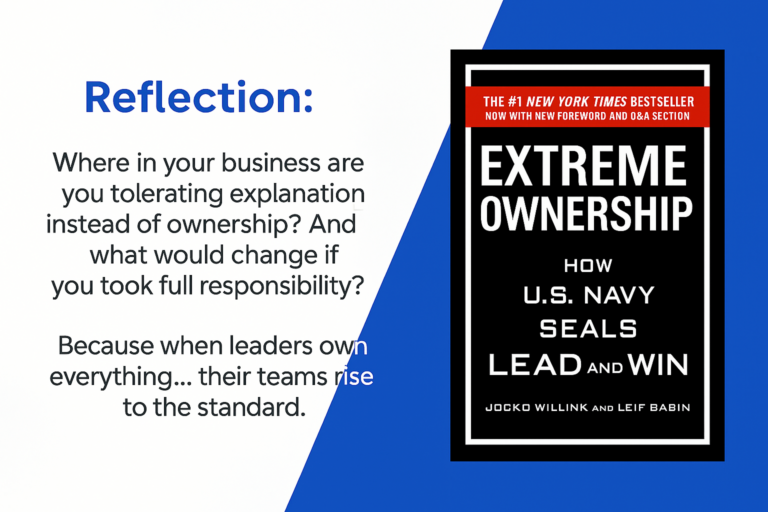
In their book Extreme Ownership: How US Navy Seals Lead and Win Jocko Willink and Leif Babin, both former U.S. Navy SEALs, deliver a simple but confronting message:
Leaders must own everything in their world.
Not some things. Not the easy things. Everything.
When a team fails, the leader owns it. When communication breaks down, the leader owns it. When standards slip, the leader owns it.
Extreme Ownership eliminates the blame game. There’s no room for ‘they didn’t execute’ or ‘the market shifted’ or ‘my team dropped the ball.’
Instead, the mindset shifts to:
What did I miss?
What didn’t I communicate clearly?
Where did I fail to set the standard?
And here’s the powerful truth: Ownership creates control.
The moment you stop blaming circumstances, you regain the ability to influence outcomes.
Willink & Babin argue that high-performing teams don’t waste energy defending themselves – they channel it into fixing problems. Leaders who model ownership create a culture where accountability becomes normal, not forced.
Many companies have core values written on walls, but few translate them into real, enforceable standards that guide day-to-day decisions.
This article by GSD (Get Strategy Done) explains why shifting from aspirational values to actual non-negotiables changes the culture game entirely. Non-negotiables aren’t just what you want to believe – they are the standards you refuse to compromise on, even when it’s inconvenient.
This shift forces real accountability, influences actual behaviour, and makes culture something lived every day, not just displayed in posters. In short, it sets standards that are comfortable to walk past.
If your stated values aren’t shaping behaviour or decisions, i.e., setting standards, they’re effectively decoration. Turning them into non-negotiables forces alignment across hiring, performance reviews, meetings, and everyday interactions and builds a stronger, more disciplined culture as a result.
“Core values are what you want. Non-negotiables are what you will not live without… One is a statement. The other is a standard.”
As your business grows, complexity increases. The temptation is to add more process, more reporting, more layers.
But sometimes the answer is simpler: Raise the standard.
Because clarity + ownership + high standards = momentum. And momentum compounds.
Frank Costa set his standards with his ‘northbound train’.
Ron Shaich had his “honesty is helpful.”
What is your standard? And are you living it loudly enough that your team knows exactly what train they’re boarding?
Until next time, keep Planning, Growing & Succeeding!